

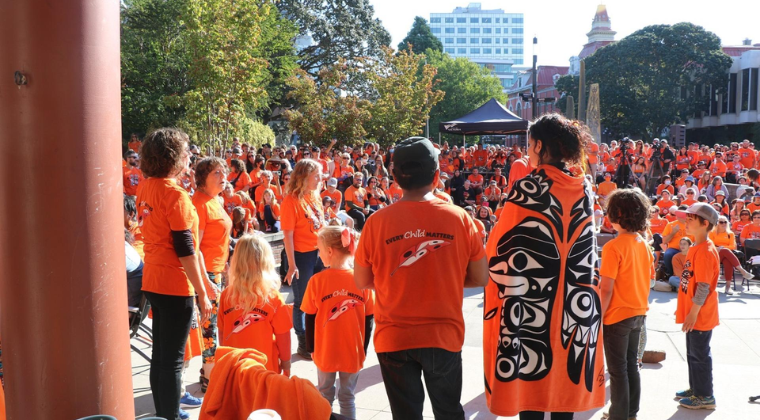
September 30 is a Day for Remembering and a Responsibility to Keep Learning
What the National Day for Truth and Reconciliation can mean for workplaces, including small and medium-sized businesses
Every September 30, people across Canada mark the National Day for Truth and Reconciliation and Orange Shirt Day. It is a day of remembrance, learning and reflection: an opportunity to honour Survivors of residential schools, remember the children who never returned home, recognize the experiences of their families and communities, and deepen our understanding of the ongoing impacts of colonialism in Canada.
For workplaces, September 30 also raises an important question: what role can organizations play in advancing truth and reconciliation?
Reconciliation cannot be reduced to a social media post, an orange shirt or a single annual training session. Nor is it solely the responsibility of governments, large corporations or organizations with dedicated Indigenous relations teams. Small and medium-sized businesses, nonprofits and other workplaces also have opportunities to contribute through learning, relationship-building and meaningful action.
For smaller organizations in particular, that can sometimes feel intimidating. Leaders may wonder whether they have the expertise, resources or budget to do something meaningful. They may worry about doing or saying the wrong thing, or creating a gesture that feels performative rather than substantive.
But meaningful participation does not necessarily require a major initiative. Sometimes it begins with creating the space to learn.
Why the National Day for Truth and Reconciliation Matters

The National Day for Truth and Reconciliation was established by the federal government in 2021 in direct response to Call to Action 80 of the Truth and Reconciliation Commission of Canada. That Call to Action asked the federal government, in collaboration with Indigenous Peoples, to establish a statutory holiday to honour Survivors, their families and communities and to ensure that the history and legacy of residential schools remain an important part of public commemoration in Canada.
The day coincides with Orange Shirt Day, a grassroots movement that predates the federal holiday and grew from the experience of residential school Survivor Phyllis Webstad.
Webstad has shared the story of arriving at St. Joseph Mission Residential School as a six-year-old child wearing a new orange shirt that her grandmother had bought for her. The shirt was taken from her when she arrived at the school. Her experience became the foundation for Orange Shirt Day and the message Every Child Matters, symbolizing the profound loss of identity, culture, dignity, family connection and belonging experienced through the residential school system.
September 30 was intentionally chosen for Orange Shirt Day in part because this was traditionally the period of the year when many Indigenous children were taken from their families and sent to residential schools. The day therefore carries particular significance for Survivors and their families.
The residential school system was not an isolated historical event. The federal government identifies 140 federally run residential schools that operated between 1867 and 1996, and the Truth and Reconciliation Commission spent years documenting the experiences of Survivors and the profound intergenerational consequences of the system.
The National Centre for Truth and Reconciliation has repeatedly emphasized that September can be an especially difficult period for Survivors because it recalls the time when children were separated from their homes, families and communities. The purpose of the day, therefore, is not celebration. It is remembrance, truth-telling, education and a renewed commitment to reconciliation.
September 30 should not simply become another themed workplace observance. It asks organizations to consider the history of the country in which they operate, their relationship with Indigenous Peoples and communities, and the role they can play in building greater understanding.
Truth and Reconciliation is also a Workplace Responsibility
One of the most important aspects of the Truth and Reconciliation Commission’s Calls to Action is that responsibility for reconciliation extends well beyond government.
Call to Action 92 specifically addresses Canada’s corporate sector. Among other commitments, it calls on businesses to provide education to management and staff about the history of Indigenous Peoples, including the history and legacy of residential schools, Treaties and Indigenous rights, Indigenous law, and Indigenous–Crown relations. It also identifies intercultural competency, conflict resolution, human rights and anti-racism education as important components of this work.
Although the language refers to the corporate sector, its underlying principle is relevant to organizations of every size. A five-person nonprofit may not have the resources of a national corporation, but it can still create space for its employees to learn. A local business can purchase books by Indigenous authors, compensate an Indigenous educator to speak with its staff, support an Indigenous-owned business or encourage employees to participate in community events.
A workplace does not need an elaborate reconciliation strategy before it can begin. In fact, waiting until an organization feels it can do everything perfectly can become another reason to do nothing.
Make September 30 a Starting Point for Workplace Learning
One of the risks associated with commemorative days is that organizations concentrate all of their attention into a single date. An employee receives an email on September 30. The organization’s logo becomes orange. Someone shares a land acknowledgement. Perhaps a webinar is offered. Then October 1 arrives and the conversation disappears.
This is not unique to reconciliation. Organizations can fall into the same pattern around Pride Month, Black History Month, International Women’s Day and other significant dates. Visibility increases temporarily without necessarily changing what people understand, how an organization operates or what relationships it builds.
September 30 can instead function as an intentional point in a longer learning journey. For an organization at the very beginning, that might mean learning about the residential school system and the Truth and Reconciliation Commission’s Calls to Action. For another organization, it may mean examining its procurement practices and looking for opportunities to work with Indigenous-owned businesses.
For employers that recruit in communities with significant Indigenous populations, it could mean examining barriers within hiring, advancement and retention. For organizations that work directly with First Nations, Métis or Inuit communities, the conversation may need to move much further toward relationship-building, consultation, reciprocity and accountability.
Reconciliation will not look identical in every workplace because organizations have different histories, geographic contexts, relationships and spheres of influence. What matters is movement beyond symbolic recognition toward sustained learning and action.
How Small and Medium-Sized Businesses Can Support Reconciliation
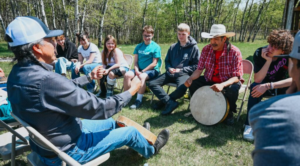
A small organization can begin by dedicating working time to learning. Rather than sending employees a link and asking them to engage with it on their own time, a workplace might block an hour in everyone’s calendars for an Indigenous-led webinar or educational session.
Organizations can invite an Indigenous knowledge keeper, educator, Elder, author or community leader to speak with the team, following appropriate local protocols and ensuring that their knowledge and time are compensated appropriately.
A workplace might host a lunch and learn on residential schools, Treaties, Indigenous history in its region, contemporary Indigenous issues or what reconciliation can look like within its own sector.
The National Centre for Truth and Reconciliation itself provides educational opportunities around Truth and Reconciliation Week. In 2026, its programming includes educational programming and Lunch & Learn webinars, alongside commemorative activities associated with September 30.
Organizations can also use structured learning resources. One example is Four Seasons of Reconciliation, developed in partnership with First Nations University of Canada and Reconciliation Education. The program addresses the history and contemporary realities of Indigenous Peoples, Treaties, residential schools, colonialism and reconciliation, and was designed in part to help workplaces respond to Call to Action 92.
The point is not that every workplace needs to select the same course or activity. Rather, employers can make Indigenous learning part of paid professional development rather than positioning reconciliation solely as something employees should learn about independently.
That sends an important message: understanding the country, communities and histories within which we work is relevant to our professional responsibilities.
If Employees Have the Day Off, Give the Day Meaning
It is also important to recognize that September 30 is not a statutory holiday for every employee in Canada. The National Day for Truth and Reconciliation is a federal statutory holiday, while provincial and territorial approaches differ. In Alberta, for example, September 30 is currently listed as an optional general holiday rather than one of the province’s nine statutory general holidays, although employers may choose to recognize it.
For organizations that do provide employees with the day off, there is an opportunity to talk about why. Giving people a holiday without any context can unintentionally turn a day intended for remembrance into simply another long weekend. Employers do not need to prescribe how people spend their personal time. But they can provide employees with information and options.
Someone might choose to attend a local Indigenous-led commemoration or ceremony. Another person might watch a Survivor talk, attend a webinar or spend part of the day reading a book by an Indigenous author. Families might participate in community programming together. Employees may visit an Indigenous cultural centre, museum or historic site, where appropriate, to learn more about local history. There can also be meaning in simply spending intentional time on the land.
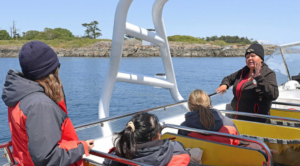
A walk or hike, for example, should not be presented as an act of reconciliation by itself. But it can become an opportunity to learn whose traditional territory you are on, the Treaty history of the region, the Indigenous names and histories associated with the land, and the relationships Indigenous communities have maintained with that place across generations. A land acknowledgement becomes substantially more meaningful when we actually know something about the land we are acknowledging.
Instead of simply saying, I am grateful to be on this land, we can ask: Whose land is this? What agreements made it possible for me to live here? What history occurred here? Which Indigenous communities live here today? What responsibilities flow from that knowledge?
Reconciliation begins with truth. Curiosity can be one of the ways we move toward it.
Centre Indigenous Voices and Leadership
Whatever organizations choose to do, Indigenous voices should remain at the centre of learning about Indigenous experiences. There is an important difference between creating space for education and speaking on behalf of Indigenous Peoples.
Where possible, workplaces can seek out Indigenous-led organizations, speakers, authors, educators and community events. This not only produces better learning; it recognizes that Indigenous people should be compensated for the expertise, knowledge and emotional labour involved in educating others.
What We Have Learned at Canadian Equality Consulting
At Canadian Equality Consulting, our own approach to September 30 has continued to evolve over time. One of the most valuable lessons for our team has been that there is no single activity that suddenly makes an organization knowledgeable about reconciliation. Learning has been cumulative.
Our team has completed the Four Seasons of Reconciliation e-learning program, developed in partnership with First Nations University of Canada and Reconciliation Education. Rather than treating that course as the completion of our learning, we have tried to use it as part of a broader foundation.
We have hosted and attended webinars led by Indigenous educators including Lorelei Parker, brought speakers into our own internal Lunch & Learns, and partnered with clients to offer learning events and webinars to their teams.
We have also moved our learning beyond our screens. Members of our team have attended Indigenous book launches, ceremonies, community events and guided hikes connected to September 30. We incorporate Indigenous Knowledge Keepers, Elders and learnings into all of our annual in-person retreats. These experiences have given us different opportunities to listen, learn and engage with Indigenous histories and perspectives in the communities where we live and work.
Some activities have been structured professional education. Others have simply involved showing up, listening and participating respectfully when Indigenous communities have invited the broader public to do so. None of those experiences represents an endpoint. That may be one of the most important principles we have learned about reconciliation: there is no certificate that allows an individual or organization to declare itself finished.
Orange Shirt Day Matters and So Does What Comes Next
Wearing orange remains an important and visible way to recognize Orange Shirt Day. The Orange Shirt Society encourages Indigenous and non-Indigenous people alike to participate, while emphasizing that truth and reconciliation are a shared responsibility and that participation should centre humility, listening and learning from Survivors and their families.
The National Centre for Truth and Reconciliation has repeatedly emphasized that telling and learning the truth is foundational to reconciliation and that the responsibility to continue this work does not belong to Indigenous Peoples alone.
Moving from Commemoration to Ongoing Reconciliation
Perhaps the most meaningful question an organization can ask on September 30 is not simply, What are we doing for National Day for Truth and Reconciliation?
It is: What relationship do we want to have with reconciliation during the other 364 days of the year?
For some workplaces, September 30 will begin with education. For others, it may create a conversation about Indigenous recruitment, procurement, partnership or community investment. Some organizations may examine whether their existing land acknowledgement is meaningful or simply recited. Others may decide to build Indigenous history and reconciliation into onboarding, leadership development or annual learning. And some small businesses may simply make a commitment that each year they will learn one thing they did not know before, participate in one Indigenous-led community initiative and support one Indigenous organization, creator, educator or business.
Small actions should not be confused with systemic change. But neither should we underestimate the cumulative effect of thousands of organizations choosing to know more, listen more carefully and behave differently. Reconciliation is, by definition, relational.
It cannot be accomplished through a single statement, training session, policy or day of observance. It develops through truth, accountability, learning, changed behaviour and relationships sustained over time.
September 30 gives Canada an important moment to stop. To remember the children who were taken. To honour Survivors and their families. To listen. To learn. And then, importantly, to continue.
Because the purpose of the National Day for Truth and Reconciliation is not simply to remember Canada’s history for one day. It is to allow that truth to change what we do next.
Related Articles
- Truth and Reconciliation – September 30th and Beyond
- National Day for Truth and Reconciliation: How Workplaces Can Take Meaningful Action
Stay Connected
Sign up for our newsletter to be the first to know.