

Dolly Parton’s 9 to 5 Legacy
What Dolly Parton’s 9 to 5 Still Teaches Us About Women, Workplace Culture and Leadership
More than four decades after its release, Dolly Parton’s 9 to 5 remains one of the most recognizable songs ever written about work. Its upbeat tempo and wit can make it easy to hear as a lighthearted workplace anthem, but behind the song is a much bigger story about women, workplace culture, gender equity and leadership.
9 to 5 emerged from a period in which women were entering the paid workforce in growing numbers while continuing to encounter low wages, limited advancement, sexual harassment, discrimination and deeply gendered expectations about who should hold authority in the workplace. The song captured these conditions with unusual cultural force, translating a broader movement for workplace equality into popular music.
The Workplace Movement Behind 9 to 5
Its origins are closely tied to the real 9to5 movement, founded in Boston in 1973 by women clerical workers seeking better pay, working conditions and respect. Clerical work was heavily feminized and often treated as low-status despite being essential to organizational functioning. Women working in these roles described being expected to perform personal errands for male supervisors, being denied opportunities for advancement, facing sexual harassment and, in some cases, training men who would later be promoted above them. What began as conversations among office workers eventually became a broader organizing movement focused on workplace rights, pay equity and dignity at work.
When Individual Experiences Reveal Workplace Culture Problems
One of the most important dimensions of that history is the way individual experiences became recognizable as structural problems. A difficult supervisor, an unfair promotion decision or an inappropriate comment can easily be interpreted as an isolated event when employees experience them separately. When people begin comparing experiences, however, patterns become visible. What appears to be an individual problem may instead be the product of organizational systems, norms and power relationships.
That insight remains central to contemporary work on workplace culture and equity. Organizations often understand culture through individual behaviour, but culture is also created through repeated organizational decisions: who is promoted, whose ideas receive credibility, how performance is evaluated, which behaviours are tolerated, who receives access to influential leaders, and whose mistakes are treated as evidence of broader incompetence. The 9to5 movement demonstrated that workplace inequity does not require explicit discriminatory policies to persist. It can be embedded in expectations, informal practices and patterns of decision-making that gradually determine who has access to opportunity and power.
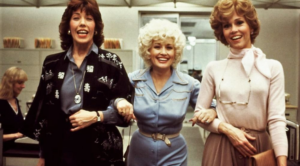
Jane Fonda eventually became interested in the stories emerging from the movement and met with women involved in 9to5 to understand their experiences. Those conversations contributed to the development of the 1980 film 9 to 5, starring Fonda, Lily Tomlin and Dolly Parton. The film uses comedy to portray a workplace dominated by an egotistical and sexist executive, but underneath the exaggerated plot are recognizable workplace dynamics: sexual harassment, unequal opportunities, gender stereotyping, arbitrary managerial power and the systematic undervaluing of women’s work.
The decision to tell the story through comedy was culturally significant. Issues such as workplace harassment, discrimination and gender inequality could have been framed as a serious political drama. Instead, the film made them accessible to a mass audience by presenting situations that many women recognized immediately, while also allowing audiences to confront uncomfortable workplace realities through humour. In doing so, 9 to 5 helped move conversations that had largely been occurring within women’s organizations and labour movements into mainstream popular culture.
Gender Bias and the Changing Definition of Leadership
Dolly Parton’s contribution added another layer to that cultural impact. Parton reportedly wrote much of the song while working on the film, using the clicking of her acrylic fingernails to mimic the sound of typewriters. That rhythm eventually became part of the recording itself. There is something symbolically fitting about this detail. Parton’s appearance had long been part of her public persona, and it was also something that could cause people to underestimate her intelligence, business acumen and creative authority. The fact that one of the most recognizable rhythms in popular music was created using the very acrylic nails that could invite those stereotypes is an interesting reminder of how quickly workplaces can mistake appearance, personality or communication style for competence.
That issue remains highly relevant to gender equity today. Many workplace biases are no longer expressed through explicit statements that women should not hold certain roles. Instead, they appear through judgments about leadership style, professionalism, confidence, executive presence or “fit.” Women may be perceived as insufficiently assertive when they communicate collaboratively, but overly aggressive when they communicate directly. Employees whose appearance, speech patterns, caregiving responsibilities or interpersonal style fall outside familiar leadership norms can find their competence questioned in ways that have little relationship to their actual performance.
When 9 to 5 was released, it became an extraordinary commercial success, reaching number one on both the Billboard Hot 100 and country charts and earning Parton major awards and an Academy Award nomination. The song articulated a widespread frustration with workplaces in which employees could work hard while having little control over the conditions of their work or access to the rewards generated by their labour.
Why Workplace Inequity Is a Leadership Issue
The song is a critique of poorly designed and inequitable work. The people at the centre of both the real movement and the fictional film are not disengaged employees seeking to avoid responsibility. They are capable workers frustrated by systems that fail to recognize their contributions, distribute opportunity fairly or provide meaningful agency.
That remains an important lesson for leaders working to build more equitable workplace cultures.
Contemporary conversations about employee engagement sometimes focus heavily on individual motivation: whether employees are resilient enough, committed enough, productive enough or sufficiently adaptable to organizational change. Those questions matter, but they can become problematic when they encourage leaders to treat structural workplace problems as individual attitude problems. An employee who is disengaged because they have repeatedly been overlooked for advancement does not necessarily need another engagement initiative. A woman experiencing a persistent pay disparity does not simply need negotiation training. Employees who lack flexibility because organizational systems were designed around a traditional worker without caregiving responsibilities may not need greater resilience; the organization may need to reconsider how work itself is structured.
Effective leadership therefore requires examining whether organizational systems enable people to contribute and advance equitably. This includes scrutinizing compensation practices, promotion criteria, access to stretch assignments, sponsorship opportunities, flexibility policies, performance evaluation and the informal networks through which influence often operates. Gender equity is not achieved simply by removing explicitly discriminatory rules. It requires attention to the subtler organizational mechanisms through which opportunity continues to be distributed.
Women in Leadership and the Cumulative Impact of Canadian Workplace Systems
The progress made since 1980 is substantial. Women have entered professions and leadership positions that were far less accessible when the film was released, and legal protections relating to discrimination, harassment and pay equity have strengthened considerably. Yet gender disparities remain visible across Canadian workplaces. Women continue to earn less on average than men, remain underrepresented in senior leadership and experience different outcomes depending on race, Indigeneity, disability, immigration status and other intersecting identities.
These disparities are particularly important because inequality often accumulates gradually across careers. Small differences in hiring decisions, performance ratings, access to mentoring, parental leave experiences, stretch assignments and sponsorship can compound over time. An organization may begin with relatively balanced representation at entry levels while becoming progressively less representative at senior levels. The problem may not be a single discriminatory decision but the cumulative impact of hundreds of decisions shaped by assumptions about who appears ready, committed, authoritative or leadership material.
Gender Equity Requires More Than Representation
For this reason, organizations need to move beyond representation as their primary measure of gender equity. Representation remains important, but the more meaningful question is whether employees have equitable access to influence, opportunity and decision-making power.
This distinction between representation and influence is one of the enduring lessons of the 9 to 5 story. The women at the centre of the film do not simply want access to the workplace; they want a workplace that reflects the realities of the people working within it. When they gain greater control over the organization, they introduce changes relating to flexibility, job sharing, childcare and employee autonomy. Although these ideas are presented comedically, they reflect an important shift in organizational thinking: workplaces should not be designed exclusively around the needs and assumptions of those who historically held power.
That principle remains highly relevant to inclusive leadership and workplace culture today. Many long-standing workplace practices were developed during periods when leadership ranks were considerably more homogeneous and when expectations about family, caregiving and employment were very different. Some practices remain not because they are demonstrably effective, but because they are familiar. Leaders committed to equity must therefore be willing to ask whether existing systems continue to serve the workforce they actually have.
Employee Voice Can Reveal What Workplace Data Misses
The history of the 9to5 movement also offers an important lesson about employee voice. The movement gained momentum when women began sharing their experiences and recognizing patterns across workplaces. Modern organizations have considerably more sophisticated tools for doing this: employee surveys, focus groups, demographic analysis, stay interviews, exit data, pay equity audits, promotion data and qualitative listening exercises. Yet collecting information is not sufficient. Leaders must be prepared to examine patterns within the data, particularly where aggregate results may hide significantly different experiences among groups of employees.
An organization, for example, may report strong overall engagement while women experience lower perceptions of advancement opportunity. Overall belonging scores may appear positive while racialized women or women with disabilities report substantially different experiences of psychological safety. A workplace may appear equitable when looking at recruitment while revealing significant disparities in promotion and retention. Aggregate averages can therefore create a misleading picture of workplace culture unless organizations are willing to look beneath them.
What 9 to 5 Can Still Teach Today’s Leaders
There is a larger leadership principle embedded within all of this. Strong leaders do not assume that the workplace they inherited is necessarily the workplace that should continue to exist. They remain curious about how systems affect different employees, whose needs are centred within existing practices and whose experiences may be less visible to those at the top of the organization. They understand that maintaining an established system is itself a leadership decision.
That is ultimately why Dolly Parton’s 9 to 5 continues to resonate. It belongs to a specific moment in the history of women’s workplace participation, but the questions it raises remain remarkably current. Who benefits from the way work is structured? Whose contributions are recognized? Who receives access to opportunity and authority? Which employees are expected to adapt themselves to the organization, and when should the organization instead adapt its systems to better reflect its people?
More than forty years later, the vocabulary of workplace equality has changed considerably, but the central challenge remains familiar. Gender equity requires more than inviting women into institutions and systems that were historically designed without them in mind. It requires examining those systems, understanding where inequity continues to emerge and being willing to redesign how opportunity, recognition and power are distributed.
The lasting significance of 9 to 5, then, is not simply that Dolly Parton wrote an exceptionally good song about an unpleasant boss. It is that the song captured a broader realization among working women: when the same workplace problem is experienced repeatedly by many different people, it should no longer be understood only as an individual problem.
Related Articles
Stay Connected
Sign up for our newsletter to be the first to know.