


From Resistance to Champions: Converting Your Biggest Skeptics Into Inclusion Advocates
In nearly every organization, inclusion efforts encounter resistance.
Not always loudly, but consistently enough to slow progress, dilute impact, or keep well-intentioned strategies from translating into meaningful change.
The instinct is often to push harder. To reinforce the message, increase urgency, or double down on training. But resistance to inclusion isn’t something to overcome. It’s something to understand.
Because at its core, this isn’t just an inclusion challenge. It’s a change and leadership challenge. One that directly impacts workplace culture, team effectiveness, and long-term employee engagement.
Across sectors, we continue to see the same pattern: organizations make the most progress not when they try to persuade skeptics, but when they design change in a way people can actually engage with clearly, practically, and with confidence over time.
Because skeptics are not always blockers. With the right approach, they often become some of the strongest advocates for more inclusive, high-performing teams.
Want to move inclusion from resistance to meaningful engagement? Explore how practical learning, leadership development, and Culture 360 resources can support stronger workplace cultures over time. Connect with us at hello@canadianequality.ca to continue the conversation.
Understanding Resistance: Why Smart People Push Back on Inclusion Initiatives
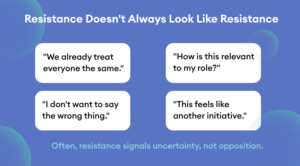
Resistance rarely presents itself as open opposition. More often, it shows up as hesitation. Questions about relevance. Disengagement during conversations that feel abstract, unclear, or disconnected from day-to-day work.
One of the most common patterns we see in leadership discussions is not disagreement with inclusion itself, but uncertainty about expectations.
Questions like:
- “What does this actually look like in practice?”
- “How does this apply to my role?”
- “What if I say the wrong thing?”
These moments are important because they reveal something many organizations overlook: resistance is often less about intent and more about ambiguity.
When inclusion is positioned as something separate from operational priorities, leaders struggle to connect it to how they already lead teams, make decisions, or manage performance. The work begins to feel additive rather than integrated. That’s where resistance tends to grow.
Another pattern we frequently observe is change fatigue. Many leaders are already navigating competing priorities, operational pressures, and ongoing organizational change. When inclusion is introduced as another initiative layered onto existing demands, even supportive leaders may disengage.
Not because they don’t care, but because they don’t yet see a practical path forward. This distinction matters. Because once resistance is understood as part of how people experience change, not a rejection of inclusion itself, it becomes something organizations can work with rather than against.
The Bridge-Builder’s Mindset: How to Approach Skeptics Effectively
Leaders who successfully engage skeptics approach these moments differently. They don’t start with persuasion. They start with understanding.
Instead of asking, “How do we convince them?” They ask: “What matters to them and how does this connect?” That shift changes the tone of the conversation entirely.
What we consistently see is that engagement increases when inclusion is connected to outcomes leaders already care about like team effectiveness, collaboration, decision-making, retention, and performance.
When conversations stay at the level of terminology or broad concepts, participation often remains surface-level. But when leaders begin exploring how inclusion shows up in hiring decisions, team dynamics, performance conversations, or workload distribution, the work becomes more tangible.
Another important pattern is that people engage more openly when learning is normalized.
In many organizations, hesitation is driven by fear of making mistakes publicly. Leaders worry they don’t have the right language, enough knowledge, or complete confidence in navigating nuanced conversations.
The organizations that move forward most effectively create environments where people are expected to learn and not expected to already know everything. That distinction reduces defensiveness significantly. It also creates space for curiosity, reflection, and accountability to coexist.
Over time, conversations that initially feel tense or cautious begin to shift toward practical problem-solving and shared ownership.
Strategic Approaches: Converting Resistance Into Engagement
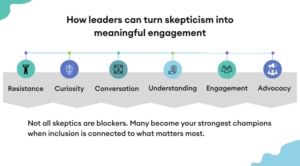
Organizations that successfully reduce resistance tend to approach inclusion as part of how the organization operates. What separates organizations that stall from those that build momentum is rarely intent. It’s whether inclusion is clearly connected to organizational strategy, leadership expectations, and everyday decision-making.
Resistance often decreases when people can see that inclusion is not “extra work,” but part of the organization’s values, leadership approach, and long-term direction.
Organizations that make progress typically embed inclusion into:
- leadership competencies
- performance expectations
- decision-making practices
- team and organizational values
When leaders are measured on inclusive leadership behaviours, not just encouraged to support them, the work becomes more consistent and credible.
Training also plays an important role, but only when it is designed to build confidence rather than compliance. One of the most common frustrations leaders express is that training can feel disconnected from the situations they are actually navigating. Awareness alone rarely changes behaviour. What creates engagement is practical learning that helps people build the tools, skills, and confidence to navigate real workplace dynamics whether that’s facilitating difficult conversations, responding to challenging comments, or recognizing bias in decision-making.
When learning feels practical and relevant, resistance often softens. In many cases, confidence is the barrier. Momentum also builds when progress becomes visible.
Organizations often underestimate the power of small, observable shifts: stronger participation in meetings, more thoughtful decision-making, or leaders approaching conversations differently.
Celebrating these moments reinforces progress and helps build momentum across teams. Just as importantly, organizations that sustain change create space for reflection, feedback, and ongoing learning. Team conversations, pulse checks, manager reflections, and post-training discussions help reinforce expectations over time. The strongest organizations don’t just measure perception. They measure action.
A simple question like:
“What is one action you’ve taken this week to apply what you’ve learned?” helps shift the focus from awareness to behaviour. Over time, these repeated moments of action, reflection, and accountability are what move inclusion from an initiative to an embedded leadership practice.
Addressing Specific Objections: Scripts and Responses

Skepticism often shows up in predictable ways. Preparing thoughtful, grounded responses helps keep conversations productive.
“This feels like a social agenda.”
Response: “I hear that. In our context, this work is about how we operate as a team, how we make decisions, collaborate, and ensure people can contribute effectively. It’s directly connected to performance and outcomes.”
“We already treat everyone the same.”
Response: “Consistency is important. At the same time, people have different experiences and starting points. This work helps ensure our processes are fair and effective for everyone.”
“I don’t want to say the wrong thing.”
Response: “That’s a common concern. The goal isn’t perfection. It’s building confidence over time. We’re here to support that.”
“This isn’t relevant to my role.”
Response: “That’s helpful to flag. Can we explore where this might show up in your day-to-day like team discussions, decision-making, or feedback conversations?”
The goal isn’t to shut down objections. It’s to work with them.
Stay Connected
Sign up for our newsletter to be the first to know.